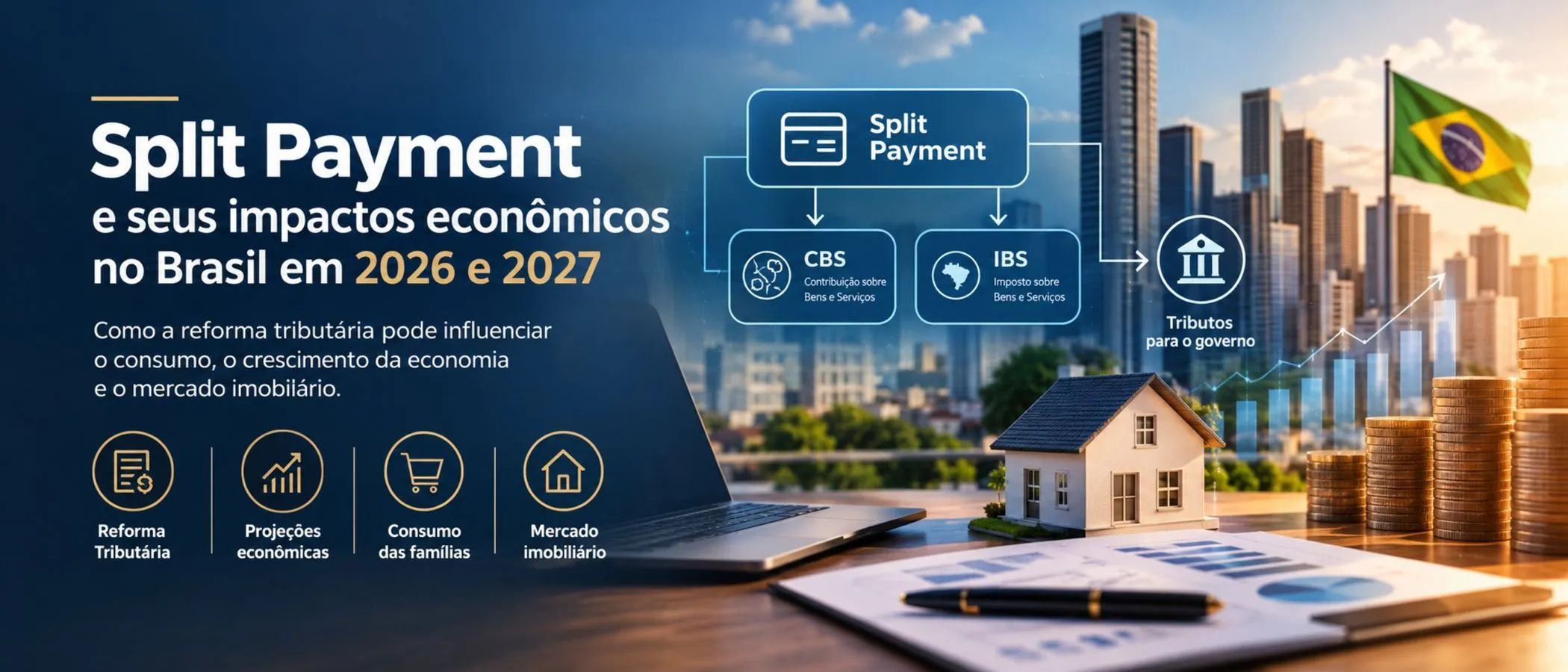
Split Payment in Brazil and Its Economic Impacts
Split Payment in Brazil: Economic Impacts, Consumer Spending Projections, and Effects on the Real Estate Market How the new tax collection system under the tax reform could transform corporate cash flow, household spending, and opportunities in the Brazilian real estate market.
Brazil’s tax reform represents one of the most important changes to the consumption tax structure in recent decades. Among the mechanisms designed to modernize tax collection is split payment, or split payment, a system that will automatically separate the tax amounts due on certain transactions at the moment the payment is settled.
The change goes beyond a technological update. It could alter companies’ financial management, reduce certain opportunities for tax delinquency, and change the way businesses manage receipts and tax credits.
For the real estate market, the effects deserve special attention. Developers, builders, real estate agencies, service providers, and investors will need to monitor regulation, operating costs, and the reform’s impact on economic activity.
But one question is essential: does split payment represent a new tax for consumers? And what are the prospects for Brazilian consumption and economic growth during this transition?
1. What is split payment and how will it work?
Split payment is a tax collection mechanism предусмотрено in the tax reform on consumption. Its purpose is to allow the tax portion of a transaction to be segregated and directed to the government during payment settlement, while the supplier receives the remaining amount.
The system is linked to the two new consumption taxes provided for in the reform:
CBS — Contribution on Goods and Services: a federal tax.
IBS — Tax on Goods and Services: a tax jointly administered by states, the Federal District, and municipalities.
The legal basis for the mechanism is Supplementary Law No. 214/2025, later amended by Supplementary Law No. 227/2026.
Official source: Supplementary Law No. 214/2025 — updated text on the Chamber of Deputies website.
How will it work in practice?
Imagine a company makes a sale and receives payment electronically. With the implementation of split payment, the system should identify the transaction and the corresponding tax amounts, segregating and collecting the taxes according to the applicable rules.
In a simplified representation:
The consumer makes the payment.
The system identifies the transaction and the corresponding tax information.
The CBS and IBS amounts subject to the mechanism are segregated.
The tax portion is collected in accordance with the legal rules.
The supplier receives the balance of the transaction, subject to the applicable procedures.
The model established by law provides for standard and simplified procedures, with specific rules for identifying amounts, using credits, and collecting taxes.
Important: split payment does not, by itself, create a new tax. It changes the way the taxes covered by the system are collected. Therefore, it is not correct to say that its implementation will automatically cause prices to rise for all consumers.
Source: Supplementary Law No. 214/2025, especially Articles 31 to 35.
2. When will split payment begin operating in Brazil?
Implementation will take place gradually, in line with the tax reform timeline.
In a notice published on September 30, 2026, the Federal Revenue Service stated that the testing phase for integration between payment service providers and the Public Split Payment Platform would begin on October 15, 2026.
According to the agency, this first stage is technical and controlled. Transactions carried out during the tests do not result in the final collection of taxes through the system and do not affect consumers.
This detail is essential to understanding the current moment: the fact that tests are being conducted does not mean that split payment is already operating definitively across all commercial transactions in Brazil.
Implementation must follow the legal and operational milestones established by the responsible authorities, with expansion as systems and procedures are prepared.
Official sources:
Federal Revenue Service — start of tests for the Public Split Payment Platform, 09/30/2026.
Federal Revenue Service — guidance and timeline for the consumption tax reform.
3. What are the possible economic impacts of split payment?
The economic effects of the new system will depend on implementation, the rules for tax assessment and offsetting, and companies’ ability to adapt.
Reduction in tax delinquency
One of the mechanism’s goals is to make collection more integrated with payment for the transaction.
This may reduce situations in which a supplier receives the full amount of a sale but later fails to remit the tax due, subject to legal rules and the specifics of each transaction.
The change may also increase transaction traceability and support tax enforcement.
Changes in company cash flow
This is one of the points that deserves the most attention.
Under the traditional model, a company may receive the proceeds from a sale and use the available funds to manage expenses until taxes are due.
With split payment, the tax portion covered by the mechanism may be directed to collection at the time of financial settlement. As a result, the supplier may immediately receive a lower net amount, even though the tax has already been collected.
This does not necessarily mean an increase in the effective tax burden. It primarily means a change in the temporary availability of funds.
Companies with thin margins, installment-based sales, or long receivable cycles will need to review cash projections, working capital needs, and financing conditions.
Tax credits and operating costs
The reform also provides rules for the appropriation and use of CBS and IBS credits. The financial result will depend on the company’s activity, the applicable tax regime, and the characteristics of its operations.
If there is a delay in recovering or offsetting credits, certain companies may face a greater need for working capital. On the other hand, more efficient procedures and proper assessment may help reduce inconsistencies and improve tax predictability.
The net impact, therefore, will not be the same across all sectors.
Prices and inflation: will costs be passed on to consumers?
Split payment, by itself, does not automatically lead to higher prices.
However, technology adaptation costs, working capital management, and possible changes in financing costs may influence business decisions.
Some of these costs may be absorbed by businesses; others may be passed on to customers, depending on competition, profit margins, and each sector’s bargaining power.
The tax reform may also change the effective burden on certain activities, but this analysis must be made separately from the operational effect of split payment.
For this reason, the most prudent assumption is that price impacts will be heterogeneous and will depend on the economic and tax conditions of each transaction.
4. Brazil’s economic projections for 2026 and 2027
To assess the potential effects of the reform on consumption, it is necessary to observe the performance of the Brazilian economy and expectations for the coming years.
The October 2026 scenario points to positive but moderate economic growth.
According to the September 2026 Macrofiscal Bulletin, the Economic Policy Secretariat of the Ministry of Finance projected 2.0% GDP growth in 2026 and 2.3% in 2027.
In October, the International Monetary Fund (IMF) projected 2.2% growth for Brazil in 2026 and 1.9% in 2027.
The estimates differ because they use their own assumptions and methodologies. Even so, they point to an economy that continues to grow, without indicating an exceptional acceleration in activity.
IndicatorProjection for 2026Projection for 2027GDP — Ministry of Finance2.0%2.3%GDP — IMF2.2%1.9%
Sources:
Ministry of Finance — GDP projections for 2026 and 2027, 09/22/2026.
Agência Brasil — IMF projects 2.2% growth for Brazil’s GDP in 2026, 10/13/2026.
These projections do not represent a standalone estimate of split payment’s impact. They describe the macroeconomic scenario in which the reform will be implemented.
5. Household spending: what do official data show?
Household spending is one of the main components of Brazilian aggregate demand. Its performance influences retail, services, business activity, and job creation.
According to data presented by the Ministry of Finance based on IBGE National Accounts, household spending showed the following results:
PeriodHousehold spending variationYear 2024+5.1%Year 2025+1.3%Cumulative over four quarters through Q2 2026+0.9%Q2 2026, versus previous quarter, seasonally adjusted-0.4%Q2 2026, versus the same quarter of 2025+0.5%
Source: Ministry of Finance — GDP Bulletin for the second quarter of 2026.
The data reveal a significant slowdown: after growing 5.1% in 2024, household spending rose 1.3% in 2025. In the four-quarter cumulative period through June 2026, the expansion was just 0.9%.
In addition, the 0.4% decline in the quarter-on-quarter comparison shows that spending lost momentum in the second quarter of 2026.
This behavior deserves attention because an economy with more moderate consumption growth may be more sensitive to cost increases, credit constraints, and shifts in consumer confidence.
Could split payment reduce consumption?
It is not possible to say that split payment will directly cause a decline in household spending.
The impact will depend on how the change affects business costs, credit availability, prices, and consumers’ disposable income.
If implementation improves tax efficiency without creating significant financial costs, the effects on consumption may be limited.
On the other hand, if certain sectors face working capital difficulties and pass part of their costs on to prices, there may be additional pressure on household budgets.
The difference is important: the collection system is an operational and tax change, while consumption depends on a much broader set of economic factors.
6. How could tax reform influence the real estate market?
The real estate market should be analyzed from two perspectives: the direct effects of taxation on sector operations and the indirect effects stemming from economic growth, consumption, and credit.
Developers and builders
Companies developing real estate projects will need to assess how the new tax rules apply to their operations, taking into account the sector’s specific regime, allowed credits, and transitional rules.
Project financial management may require adjustments in billing systems, payment reconciliation, and working capital planning.
Because real estate projects have long cycles, changes in the cost structure may affect the financial planning of new launches.
Real estate agencies and service companies
Real estate agencies, property managers, and service providers related to the sector will also need to monitor the rules applicable to their activities.
Effective taxation may vary depending on the nature of the transaction, the tax regime, and the specific provisions of the reform.
In the case of split payment, it will be important to determine which transactions will be covered at each stage of implementation and how integration between tax documents and payment systems will occur.
Property prices and purchasing power
The final price of a property does not depend only on taxes. Land, materials, labor, production financing, demand, location, and credit availability also play a role.
If the reform raises the effective costs of certain transactions, part of that effect may be absorbed by companies or reflected in prices. If there are efficiency gains, greater transparency, and fewer distortions, economic benefits may emerge over time.
However, there is no basis for saying that all properties will become more expensive or cheaper solely because of split payment.
Rental market and household income
The rental market may also feel the indirect effects of economic changes.
If household spending and income remain under pressure, some consumers may postpone buying a home and remain in the rental market.
On the other hand, weaker purchasing power may limit tenants’ ability to pay rent, increasing the importance of prices compatible with local income levels.
Behavior will depend on employment conditions, income, housing supply, and financing costs.
7. What scenarios can be considered for 2027?
Assessment of the coming years must consider that the implementation of split payment and the tax reform transition will occur alongside other economic changes.
Efficient adaptation scenario: companies adjust their systems, manage tax credits properly, and reduce operational difficulties. In this case, the impact on consumption may be limited, while greater integration of tax data may enhance transparency.
Working capital pressure scenario: certain businesses face adaptation costs, reconciliation difficulties, or delays in credit recovery. The additional need for financing may squeeze margins, especially for smaller companies.
Gradual improvement in economic efficiency scenario: the tax transition progresses with clearer rules, fewer inconsistencies, and better financial planning. The potential benefits will depend on the effectiveness of implementation and may appear gradually.
These scenarios are analytical hypotheses, not official forecasts of split payment’s quantitative impact on GDP or consumption.
So far, the economic projections cited do not isolate the effect of this mechanism on the Brazilian economy. Therefore, it would be incorrect to attribute to it alone a specific rate of growth or contraction in consumption.
8. How should companies and investors prepare?
Preparation should begin before the system is definitively implemented in each company’s operations.
Recommended measures include:
Review the tax classification and the rules applicable to the activities carried out.
Update tax, financial, and payment reconciliation systems.
Forecast cash flow based on net sales receipts.
Assess the working capital needed to keep operations running.
Monitor Federal Revenue Service and IBS Management Committee regulations.
Simulate different scenarios for costs, prices, margins, and demand.
Seek specialized accounting and tax advice for specific decisions.
In the real estate sector, these measures are especially relevant for companies with installment-based revenues, long-term developments, or a high volume of transactions.
For investors, the main caution is to distinguish actual tax effects from expectations that have not yet been confirmed. Acquisition, sale, or investment decisions should consider the total cost of the transaction, liquidity, regional demand, and the applicable legislation.
Conclusion: tax reform calls for planning, not hasty predictions
Split payment represents an important transformation in the way consumption taxes are collected in Brazil. Its potential is linked to the integration of payment and enforcement systems, transaction traceability, and the modernization of tax administration.
At the same time, the change may require financial and technological adjustments by companies, especially regarding cash flow, working capital, and tax credit management.
The 2026 economic scenario reinforces the need for caution: while projections point to GDP growth, official data show a slowdown in household spending. In this context, changes in business costs must be monitored carefully, without assuming automatic effects on prices or demand.
For the real estate market, the outcome will depend on the combination of specific tax rules, companies’ operational efficiency, credit conditions, and households’ purchasing power.
More than anticipating broad price increases or decreases in real estate, the moment calls for quality information, financial planning, and continuous monitoring of official regulations.
At Regal Imóveis, keeping track of economic and tax changes is an essential part of responsible real estate practice, prepared to guide clients and investors in a market that is constantly evolving.
Official sources and references for consultation
Supplementary Law No. 214/2025 — updated text and split payment rules.
Federal Revenue Service — notice on split payment tests, September 2026.
Federal Revenue Service — timeline and guidance for the consumption tax reform.
Ministry of Finance — GDP and inflation projections for 2026 and 2027.
Agência Brasil — IMF projections for the Brazilian economy in 2026.